Volleyball
Gert Vande Broek – The professor, the coach
Archive
Article Sun, May 26 2019
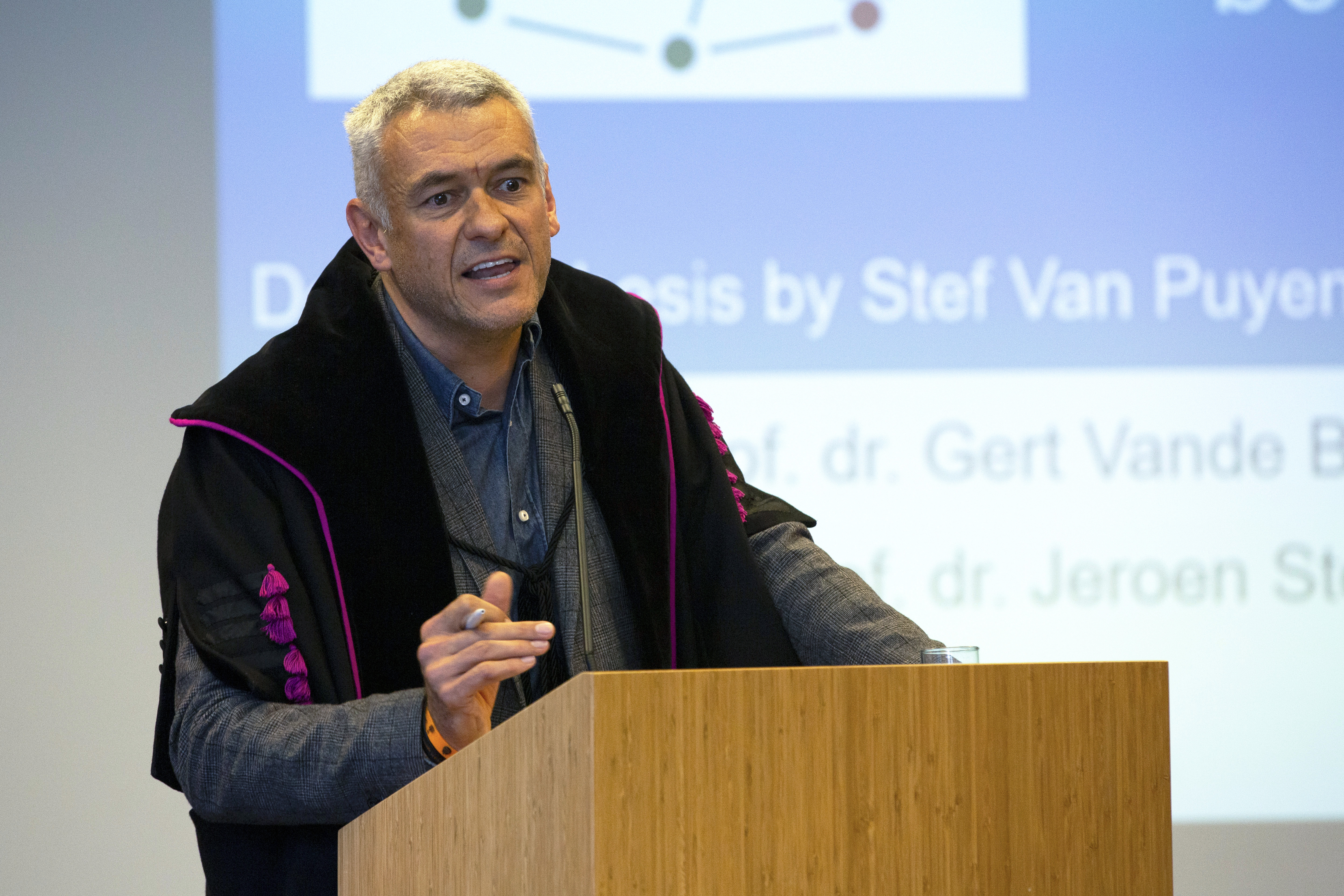
Brussels, Belgium, May 26, 2019. Gert Vande Broek has not only been the coach of the Belgian women’s national team for ten years. He is also a household name in the academic world. Professor during the day, coach in the evening.
Vande Broek’s calendar is booked, actually fully booked. That is why the end of an era is approaching. After spending 25 years as the coach of the Belgian champions, Asterix Avo BEVEREN, he left with a 13th title. After 10 years as Chef Sport, this also was the second and last term for him at the Ministry of Sports in Flanders. However, even without these two jobs, there is a lot of work left. After the summer, he will remain as Sports Director at Asterix Avo, coach of the Belgian national team and professor and researcher at the University in Louvain. “Despite everything, I am looking forward to having some free time,” the 52-year-old smiles.
There have already been many articles about his Volleyball story, but Vande Broek has written a number of scientific papers himself. “The last few years, my time as an academic researcher has gone to publication processes entirely. It costs a lot of time and the downside is that it is written for a limited target group. That is why it is time to go abroad and talk to other people about what we did. In other words, we would like to do a reality check.”
Slowing down
The Belgian coach is specialised in scientific effects, based on coaching. Of course, he takes a lot of experience with him. “I really think both worlds strengthen each other in this area. By discussing our hypotheses, we can polish the details. That is why there is a close collaboration with other universities in Leeds, Lisbon and Brisbane. After the summer programme with the Yellow Tigers, I will be travelling to these cities.”
“I won’t have a lot of spare time, but it’ll be more comfortable than the last ten years. I have worked harder than I ever thought I would. I have always liked to do what I did, but to have commitments 24/7 was weighing more and more. That is why this will be different. I will not go from appointment to appointment. By slowing down for one year, I can focus on different parts of my life, but there will also be opportunities for others.”
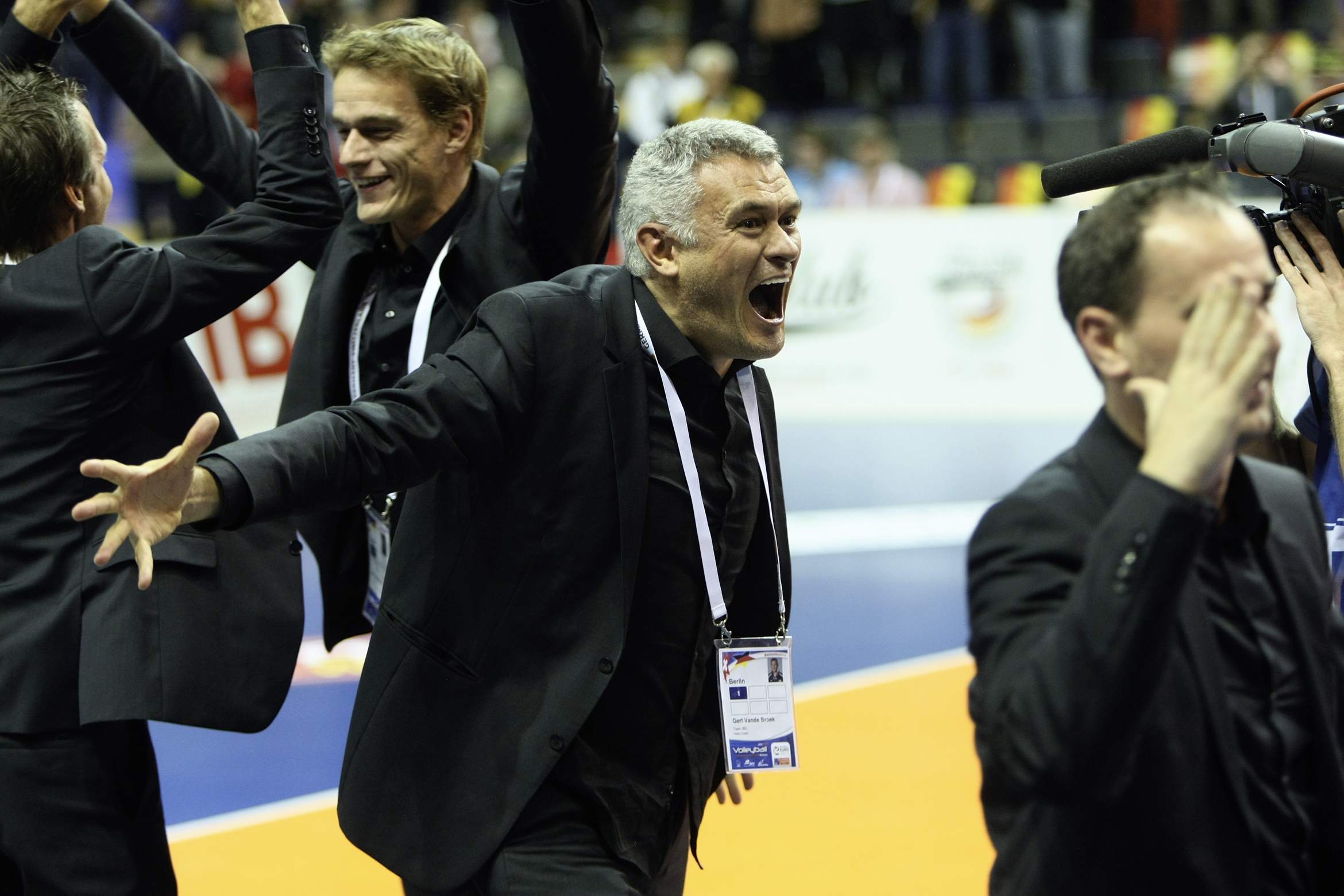
Gert Vande Broek celebrating a historic bronze medal at the 2013 edition of CEV EuroVolley Women.
Vande Broek will have many new areas of interest, led by his Ph.D. students. “All the scientific researches will focus on group dynamics and the impact of the leaders on that group. Recently, three Ph.D. studies were finished. From now on, the focus will be on the translation of these projects into practice.”
“The first thesis studied the impact of the perception of justice of the coach to the coherence of the group. What are the effects on the group if the athletes feel they are treated honestly or not by their coach? In the same study, we investigate which management styles support or subvert this perception of fairness. In a second thesis, we analysed the (de)motivating influence of coaching behaviour. This was translated to concrete and specific behaviourisms. That does not only help the practice, but it also gives an insight about how to improve the group dynamics, the motivation and the amount of self-management within the teams. The third paper focussed on the negative group dynamics that are established when a group performs below expectations. We wanted to know how negativity exists and how it spreads within the group. What’s the role of the coach and how could he fix it.”
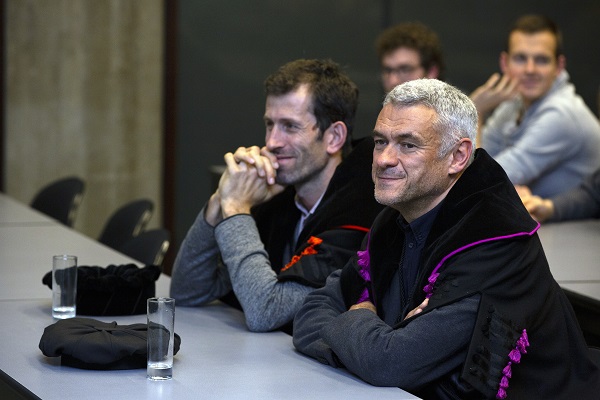
Gert Vande Broek has worked for the Flemish Government as well as Chef Sport.
Technocrat
The passion and drive in the professor’s words work infectiously. It all transcends Volleyball and finds an entrance to almost each team sport. “Also companies are interested. I like to make the link with other areas and to speak about our researches. Unfortunately, I did not have time to do that in the last few years. That’s one of the things I’d like to do from now on.”
“But I’m not planning to only focus on my academic career in the next ten years. That is not my ambition. I want to use this break to find a new goal. Probably, it will be linked to my first love: coaching. One possibility would be to coach a foreign Volleyball team; another one would be steering coaches in other sports. I am not sure yet. To me, it is also important to work together with people that are competent in a good atmosphere. One thing I am sure of, I will never leave Volleyball behind.”
What the new plan is going to be exactly is still uncertain but a surprise would not be unthinkable as Vande Broek agreed for a job as Chef Sport under Flemish Minister Philippe Muyters, ten years ago. “I have never treasured political ambitions, but I have always been interested. That I ended up at a cabinet was a coincidence: the Minister himself asked me to join his team. Therefore, I see myself as a technocrat, someone who advises politicians within his own expertise.”
“I am really happy that I could participate to reform Flemish top-class sport policy. The co-operation with the Minister and Sport Flanders was very intense and pleasant. A lot of new infrastructure was constructed and laws were written to give more autonomy to each organisation. Moreover, bridges were built between the different political departments, such as education, wellbeing and work. The social relevance of sports has increased and the definition has been broadened to an active lifestyle. Health is not the only priority when it comes to sports, but also its social importance has been underlined.”
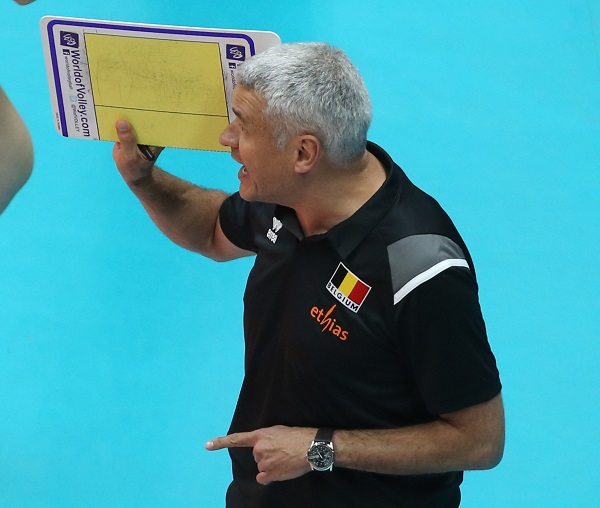
Gert Vande Broek in action during the 2019 FIVB Volleyball Nations League.
Busy, but never working
However, since the 21st May, there is only one goal for five weeks: the Yellow Tigers’ campaign in the Volleyball Nations League (VNL) in which they will travel to Bulgaria, China, Germany and Turkey. In between, the Yellow Tigers come back to Belgium to host their first VNL-tournament. A busy period for a professor that needs to grade his students. “To make sure the calendar fits isn’t an easy job at all. In January, I missed some games of the CEV Cup with Asterix Avo BEVEREN because of exams. However, the national team will always be the most important. That is something the university is aware of. Therefore, the most courses I teach are in the first term. However, there is one course, which I give from September to June. Luckily, the exam is partly multiple choice, so I have some help from the computer. It’s already happened that I’m correcting tests on a long flight, but when I set foot ashore, my core business is Volleyball.”
“Sometimes, after an intense summer campaign, my assistants show me pictures on Instagram of other coaches that come to rest around the pool. That is when I am back at the faculty to catch up with meetings. It is already sure that I will be at the university the 7th June, the day after our last VNL game in Belgium. Afterwards, we just head on to Stuttgart for the fourth week. That sounds really busy, but I have never had the feeling that I was working.”
Vande Broek’s calendar is booked, actually fully booked. That is why the end of an era is approaching. After spending 25 years as the coach of the Belgian champions, Asterix Avo BEVEREN, he left with a 13th title. After 10 years as Chef Sport, this also was the second and last term for him at the Ministry of Sports in Flanders. However, even without these two jobs, there is a lot of work left. After the summer, he will remain as Sports Director at Asterix Avo, coach of the Belgian national team and professor and researcher at the University in Louvain. “Despite everything, I am looking forward to having some free time,” the 52-year-old smiles.
There have already been many articles about his Volleyball story, but Vande Broek has written a number of scientific papers himself. “The last few years, my time as an academic researcher has gone to publication processes entirely. It costs a lot of time and the downside is that it is written for a limited target group. That is why it is time to go abroad and talk to other people about what we did. In other words, we would like to do a reality check.”
Slowing down
The Belgian coach is specialised in scientific effects, based on coaching. Of course, he takes a lot of experience with him. “I really think both worlds strengthen each other in this area. By discussing our hypotheses, we can polish the details. That is why there is a close collaboration with other universities in Leeds, Lisbon and Brisbane. After the summer programme with the Yellow Tigers, I will be travelling to these cities.”
“I won’t have a lot of spare time, but it’ll be more comfortable than the last ten years. I have worked harder than I ever thought I would. I have always liked to do what I did, but to have commitments 24/7 was weighing more and more. That is why this will be different. I will not go from appointment to appointment. By slowing down for one year, I can focus on different parts of my life, but there will also be opportunities for others.”
Gert Vande Broek celebrating a historic bronze medal at the 2013 edition of CEV EuroVolley Women.
Vande Broek will have many new areas of interest, led by his Ph.D. students. “All the scientific researches will focus on group dynamics and the impact of the leaders on that group. Recently, three Ph.D. studies were finished. From now on, the focus will be on the translation of these projects into practice.”
“The first thesis studied the impact of the perception of justice of the coach to the coherence of the group. What are the effects on the group if the athletes feel they are treated honestly or not by their coach? In the same study, we investigate which management styles support or subvert this perception of fairness. In a second thesis, we analysed the (de)motivating influence of coaching behaviour. This was translated to concrete and specific behaviourisms. That does not only help the practice, but it also gives an insight about how to improve the group dynamics, the motivation and the amount of self-management within the teams. The third paper focussed on the negative group dynamics that are established when a group performs below expectations. We wanted to know how negativity exists and how it spreads within the group. What’s the role of the coach and how could he fix it.”
Gert Vande Broek has worked for the Flemish Government as well as Chef Sport.
Technocrat
The passion and drive in the professor’s words work infectiously. It all transcends Volleyball and finds an entrance to almost each team sport. “Also companies are interested. I like to make the link with other areas and to speak about our researches. Unfortunately, I did not have time to do that in the last few years. That’s one of the things I’d like to do from now on.”
“But I’m not planning to only focus on my academic career in the next ten years. That is not my ambition. I want to use this break to find a new goal. Probably, it will be linked to my first love: coaching. One possibility would be to coach a foreign Volleyball team; another one would be steering coaches in other sports. I am not sure yet. To me, it is also important to work together with people that are competent in a good atmosphere. One thing I am sure of, I will never leave Volleyball behind.”
What the new plan is going to be exactly is still uncertain but a surprise would not be unthinkable as Vande Broek agreed for a job as Chef Sport under Flemish Minister Philippe Muyters, ten years ago. “I have never treasured political ambitions, but I have always been interested. That I ended up at a cabinet was a coincidence: the Minister himself asked me to join his team. Therefore, I see myself as a technocrat, someone who advises politicians within his own expertise.”
“I am really happy that I could participate to reform Flemish top-class sport policy. The co-operation with the Minister and Sport Flanders was very intense and pleasant. A lot of new infrastructure was constructed and laws were written to give more autonomy to each organisation. Moreover, bridges were built between the different political departments, such as education, wellbeing and work. The social relevance of sports has increased and the definition has been broadened to an active lifestyle. Health is not the only priority when it comes to sports, but also its social importance has been underlined.”
Gert Vande Broek in action during the 2019 FIVB Volleyball Nations League.
Busy, but never working
However, since the 21st May, there is only one goal for five weeks: the Yellow Tigers’ campaign in the Volleyball Nations League (VNL) in which they will travel to Bulgaria, China, Germany and Turkey. In between, the Yellow Tigers come back to Belgium to host their first VNL-tournament. A busy period for a professor that needs to grade his students. “To make sure the calendar fits isn’t an easy job at all. In January, I missed some games of the CEV Cup with Asterix Avo BEVEREN because of exams. However, the national team will always be the most important. That is something the university is aware of. Therefore, the most courses I teach are in the first term. However, there is one course, which I give from September to June. Luckily, the exam is partly multiple choice, so I have some help from the computer. It’s already happened that I’m correcting tests on a long flight, but when I set foot ashore, my core business is Volleyball.”
“Sometimes, after an intense summer campaign, my assistants show me pictures on Instagram of other coaches that come to rest around the pool. That is when I am back at the faculty to catch up with meetings. It is already sure that I will be at the university the 7th June, the day after our last VNL game in Belgium. Afterwards, we just head on to Stuttgart for the fourth week. That sounds really busy, but I have never had the feeling that I was working.”